05

Expertise

PMO & Project Management

Between a good idea and a working result lies project work. SempreAI takes on programme and project leadership, builds PMO structures and steers multi-vendor initiatives so that progress, budget and risk can be reported reliably at any time, without turning reporting into an end in itself.

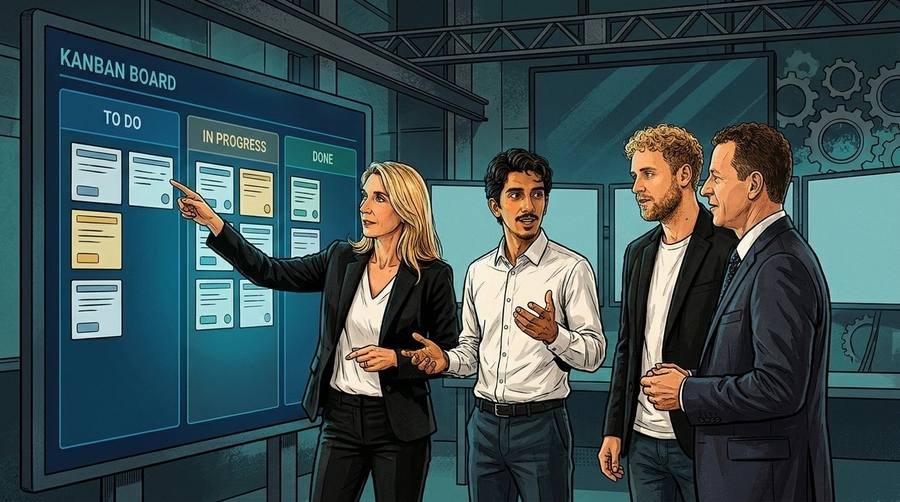
Project team steering work packages at a Kanban board

The bridge between strategy and granular delivery, in agile, traditional and hybrid models.

Overview

Why PMO & project management?

Complex initiatives rarely fail on one large problem but on many small ones: unclear decision paths, dependencies between sub-projects that nobody surveys, providers working to different methods, and status reports that obscure the real position rather than reveal it.

What carries a programme is a few consistently maintained steering instruments: a plan with real dependencies, a risk register that is actually used, and reporting that gives decision-makers exactly what they need for the next decision. Method follows the initiative and the organisation, not the other way round.

What we deliver

Services in this area

01

PMO set-up & project standards

A good PMO structure relieves project managers rather than occupying them: consistent templates, a shared delivery model and a reporting line that carries the right level of detail at every tier.

  • Establishing project and programme standards
  • Templates for charter, plan, risk and status report
  • Portfolio overview with prioritisation logic
  • Resource and capacity planning
  • Quality assurance of project documentation
  • Onboarding for new project managers

02

Programme & project leadership

Responsibility for outcome, schedule and budget is ours, hands-on and with clear communication in every direction. That includes naming problems early rather than managing them until the next status report.

  • Interim programme and project leadership
  • Planning with realistic dependencies and buffers
  • Stakeholder management across hierarchy levels
  • Risk and issue management with clear ownership
  • Steering of acceptance and milestone approvals
  • Handover into line organisation and operations

03

Agile ways of working & hybrid models

Agile and traditional are not a matter of belief. Both can be combined where it makes sense: traditional milestones and approvals outward, agile delivery teams inward, with cleanly defined interfaces between the two worlds.

  • Introduction and coaching of agile frameworks
  • Backlog structure and requirement quality
  • Hybrid models with milestone and sprint logic
  • Definition of ready and definition of done
  • Scaling across multiple teams
  • Retrospectives with actions that get implemented

04

Multi-vendor governance

Where several providers deliver, friction appears at the interfaces. Shared delivery governance helps, with consolidated reporting, clear accountability and formats in which technical questions actually get resolved.

  • Shared delivery governance across all providers
  • RACI matrix and unambiguous interface ownership
  • Consolidated reporting instead of separate reports
  • Performance assessment against agreed criteria
  • Escalation paths with defined response times
  • Regular alignment of the lead architects

05

Budget control & transparency

Budget transparency comes from clean allocation and regular forecasting. Plan, actual and forecast interlock so that deviations surface early, while countermeasures can still work.

  • Budget structure along outcomes rather than cost types
  • Continuous updating of actuals and forecast
  • Early warning indicators for deviation
  • Assessment of change requests including downstream cost
  • Traceable documentation for audit
  • Reporting for steering committees

Frequently asked questions

PMO & Project Management – Frequently asked questions

Do you work agile or traditional?
Both, and often in combination. Traditional models fit where approvals, regulation and fixed dates dominate. Agile frameworks show their strength where requirements only become precise along the way. In practice we mostly meet hybrid constellations: a milestone plan outward, agile delivery teams inward. What matters is that the interface between the two is cleanly defined.
How do you steer programmes with several providers?
Through a central steering structure with clear roles, a RACI matrix, shared delivery governance and consolidated reporting across all providers. Added to that are cross-provider programme boards, assessment criteria per provider, defined escalation paths and regular alignment formats for the lead architects. Crucially, technical clarification does not run through the status report but in formats built for it.
Do you also take on interim project leadership?
Yes. That is a frequent situation, for instance after a short-notice departure, in bridging phases, or when setting up a new programme. The lead comes with full accountability for the outcome, and the handover to an internal successor is planned from the start, including documentation and guided onboarding.
How extensive does reporting become?
As concise as possible and as detailed as necessary. Our benchmark is a status report that conveys decision relevance on one page: progress against plan, open decisions, top risks and budget position. Detail is made available on request rather than produced by default. Reporting should enable steering, not consume capacity.

Let us talk about your initiative

Whether it is a target architecture, a recertification backlog, a legacy replacement or an operations handover: describe your starting position. We will come back within one working day with a concrete assessment.