04

Expertise

Strategy & Consulting

Strategy work is valuable when it leads to decisions. SempreAI develops IT target architectures, operating models and roadmaps that are aligned to your business strategy, account for regulatory obligations and translate into budgets, milestones and accountability: prepared for the board and calculated to hold.

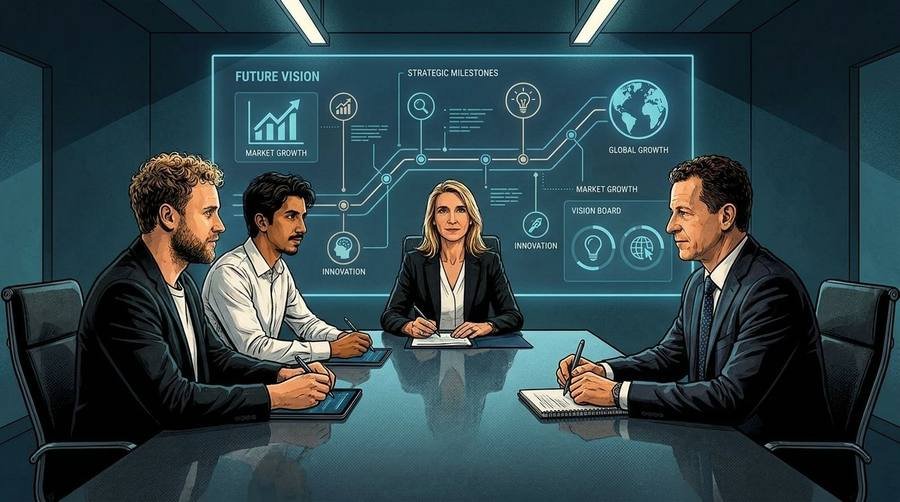
Consulting team developing a target architecture and roadmap in front of a strategy board

Long-term capability needs a roadmap that survives changing conditions, and decisions you can justify.

Overview

Why strategy & consulting?

Many transformation initiatives fail not on technology but on missing clarity: the target state stays abstract, accountability is blurred, and value cannot be evidenced to decision-making bodies. At the same time cloud migration, regulation and the use of AI change what is asked of IT organisations faster than traditional multi-year planning can represent.

Target architectures are therefore deliberately modular: one clear north star, beneath it delivery waves that each create value on their own and can be re-prioritised when conditions change. Every wave carries metrics against which progress can be measured objectively.

What we deliver

Services in this area

01

Target picture & business transformation

Business goals are translated into a future-state design with clear principles and guard rails. From it emerge fields of action that are prioritised, assessed and individually decidable, rather than a programme that only works as a whole.

  • Future-state design derived from business strategy
  • Architecture principles and decision guard rails
  • Assessment of fields of action by impact and effort
  • Communicating the future-state design to different audiences
  • Alignment with the existing application landscape
  • Delivery waves with clear outcome commitments

02

Operating model & governance

A durable operating model connects strategy, processes, roles, governance and technology. It defines decision paths and balances central steering against local delivery strength, across countries and sites.

  • Organisational structure and process model for IT functions
  • Decision paths, committees and escalation routes
  • Harmonisation of standards across regions
  • Sourcing strategy and management of external providers
  • Interfaces between business, IT and security
  • Maturity model and development path

03

Cloud & target architecture

Cloud initiatives rarely fail on technology but on governance, data protection and operating model. Target architectures therefore account for regulatory obligations, data sovereignty and identity management from the outset.

  • Target architecture for cloud and hybrid operation
  • Landing zone concept and tenant structure
  • Governance for multi-cloud and cost control
  • Integration of identity and access management
  • Data sovereignty and regulatory constraints
  • Migration roadmap with dependency analysis

04

Business case & economics

Decisions need numbers that survive a follow-up question. Every initiative is calculated with a cost baseline, benefit scenarios, sensitivity analysis and break-even, transparently derived and prepared so decision-making bodies can follow it.

  • Cost baseline and total cost view
  • Quantitative and qualitative benefit scenarios
  • Sensitivity and scenario analysis
  • Break-even and payback calculation
  • KPI framework for tracking benefits after delivery
  • Decision paper for the board and supervisory bodies

05

AI strategy & responsible use

Using AI is a governance question before it is a technical one. Sensible use cases are prioritised, data protection and copyright questions clarified, and guidelines anchored that keep accountability unambiguously with people.

  • Assessment and prioritisation of use cases
  • Guidelines for the use of generative systems
  • Data protection and confidentiality requirements
  • Positioning within the European legal framework
  • Capability building and training concept
  • Control mechanisms and human final decision

Frequently asked questions

Strategy & Consulting – Frequently asked questions

How do you calculate the value of an IT transformation?
The basis is a structured business-case model combining cost baseline, quantitative and qualitative benefit scenarios, sensitivity analysis and break-even calculation. It is complemented by metrics such as total cost reduction, cycle times, time to market and risk reduction. Assumptions are exposed rather than allowed to disappear into a single headline figure. Only then does a business case survive discussion in committee.
What makes a good operating model?
It answers four questions unambiguously: who decides what, who delivers what, how is it steered and how is it escalated. Added to that is the balance between central standardisation and local capability. A good operating model is also lean enough to actually be lived. Extensive models nobody applies do more damage than none at all.
Do you also support delivery, or only strategy?
Both, and deliberately so. Strategy work that never meets delivery reality produces future-state designs that do not hold. Typically we therefore accompany the first delivery waves as well: as programme leadership, as architecture ownership, or as a sounding board for internal teams. The transition into your own ownership is part of the plan from the start.
How do you handle existing strategy papers?
The starting point is always what already exists. Many organisations hold good analyses that were simply never translated into decisions. Currency and robustness are assessed, the missing building blocks added and the result moved into a decidable form. That saves time and respects the work your teams have already done.

Let us talk about your initiative

Whether it is a target architecture, a recertification backlog, a legacy replacement or an operations handover: describe your starting position. We will come back within one working day with a concrete assessment.